


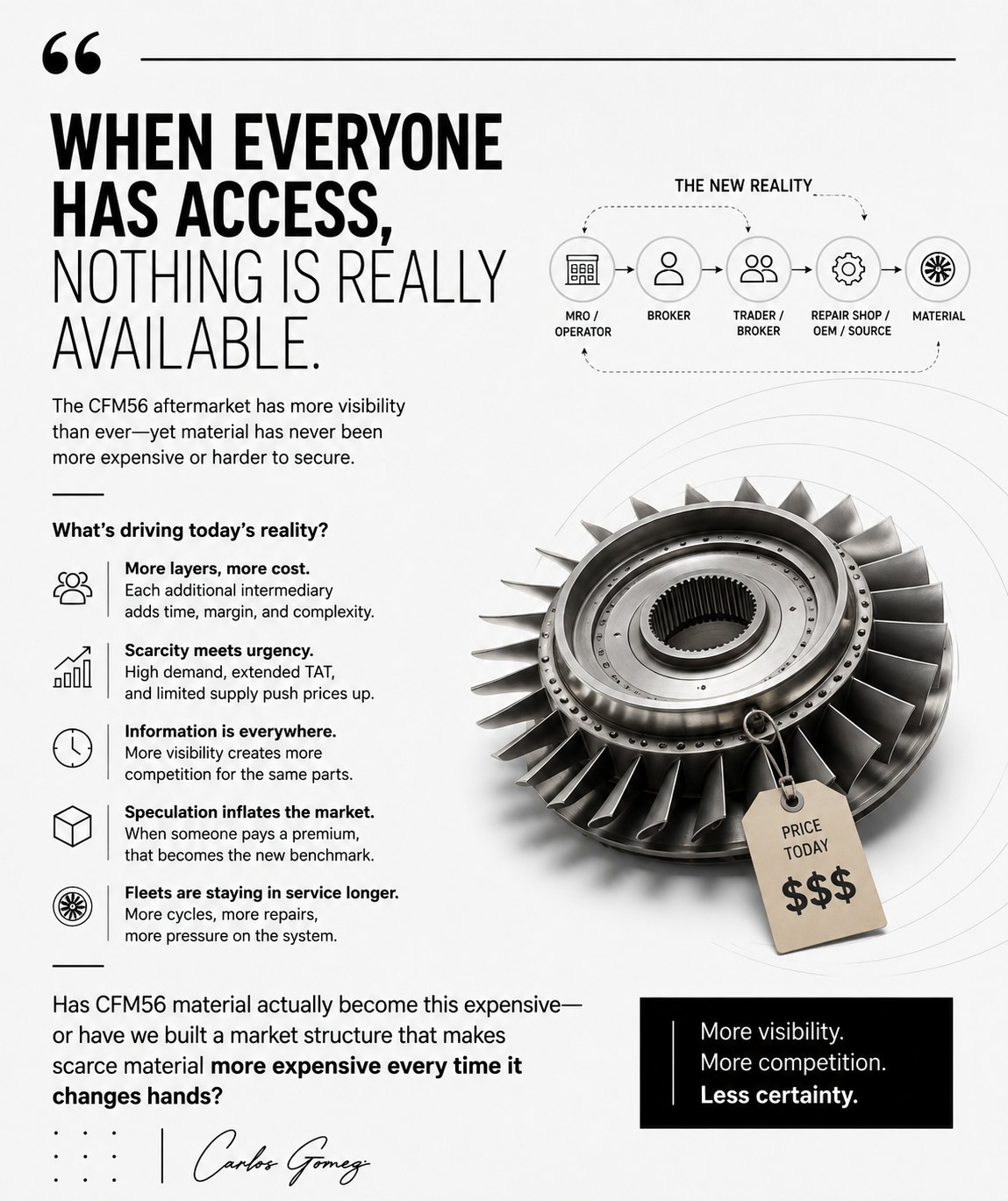
The CFM56 aftermarket has more brokers, traders, marketplaces and visibility than ever. So why has material become more expensive and, in many cases, harder to secure?
A strange thing has happened in the CFM56 material market. We have more access to material than ever before, and somehow getting the material we actually need feels harder.
That contradiction came up during a customer meeting recently. We were discussing something everyone working around CFM56 engines already knows: material has become expensive. Very expensive.
The obvious explanation is scarcity. CFM56-powered aircraft are staying in service longer, shop visit demand remains strong, repair capacity is constrained, and certain components are difficult to replace. When an engine is already sitting on the shop floor, waiting another three months for material is sometimes simply not an option. IATA now puts the average fleet age at 15.1 years and delivery shortfalls at more than 5,300 aircraft, which keeps older fleets flying and their engines cycling through shops.
All of that is real. But I think there is another part of the conversation worth having.
Access used to mean relationships
There was a time when sourcing aviation material was much more direct. A shop knew a repair source. An operator knew a teardown company. A buyer had relationships with specific suppliers. You called the person who had the material, and that relationship itself had value because not everybody knew where everything was.
Today the market works differently. A part can appear in an email blast in Miami, a broker’s inventory in Europe, a WhatsApp message in Mexico and an online marketplace almost simultaneously.
That sounds like progress, and in many ways it is. CFM built the CFM56 aftermarket as an open ecosystem, with more than 40 licensed shops and CFM itself accounting for only about a third of overhauls. The market has become more connected, more transparent and far more global.
But greater visibility has created something else: more people competing for the exact same part.
One part, five sellers
Imagine one serviceable CFM56 component enters the market. The original owner wants $20,000. A trader sees an opportunity and offers it for $23,000. Another broker knows somebody who urgently needs it and quotes $27,000. An engine is waiting on that component, so somebody eventually agrees to pay $30,000.
Nothing about the physical part changed. There is still only one. But the market just learned that someone was willing to pay $30,000 for it, and the next seller remembers that number.
That is how price discovery works in a constrained market. It does not necessarily mean anybody did anything wrong. But when inventory is scarce, urgency travels quickly through the supply chain. So does price.
Brokers are not the problem
It would be easy to turn this into an argument against brokers. That would also be wrong.
Brokers provide liquidity to an aftermarket that depends heavily on speed and relationships. They find difficult material, connect buyers and sellers across continents, finance inventory, and sometimes solve problems that traditional procurement channels cannot solve quickly enough. The industry needs them.
The more interesting question is what happens when the number of intermediaries grows faster than the amount of available material. If five companies are advertising the same component, the market may look liquid. But there are not five parts. There is one part and five routes to reach it. That distinction matters.
If five companies are advertising the same component, the market may look liquid. But there are not five parts. There is one part and five routes to reach it.
When CFM56 material meets urgency
Aviation has a characteristic that makes this market especially sensitive to price: downtime is expensive.
If a $25,000 component is preventing an engine worth millions from returning to service, paying another $5,000 or $10,000 for that component may be completely rational. The buyer is no longer comparing the price of the part. The buyer is comparing the premium against another week of downtime.
That changes pricing behavior. And once enough buyers make that calculation, emergency pricing begins influencing normal pricing. Today’s premium becomes tomorrow’s reference.
More visibility, more competition, less certainty
None of this changes the underlying reality. There is genuine pressure on CFM56 material, with real supply constraints, real repair bottlenecks, and real demand from a global fleet that continues to require maintenance. IATA and Oliver Wyman put the cost of supply chain constraints to airlines above $11 billion in 2025.
But perhaps scarcity alone does not explain everything we are seeing. The structure of the aftermarket has changed too. Material moves faster. Information moves instantly. More participants can see the same opportunity. And every participant knows that somewhere there may be an operator with an aircraft grounded, or an engine occupying a shop position, waiting for exactly that part.
We created extraordinary visibility. We may also have created extraordinary competition for scarcity.
Which leaves a question worth asking. Has CFM56 material really become this expensive because the parts are scarce, or have we also built a market where scarce material becomes more expensive every time it changes hands?
Carlos A. Gómez Zambrano
Founder and Editor of GCC Media. In commercial aviation and engine MRO since 2015, and in Miami hospitality and restaurant marketing since 2016.
Founder profile →